Maximum Mecha Turbo Overdrive
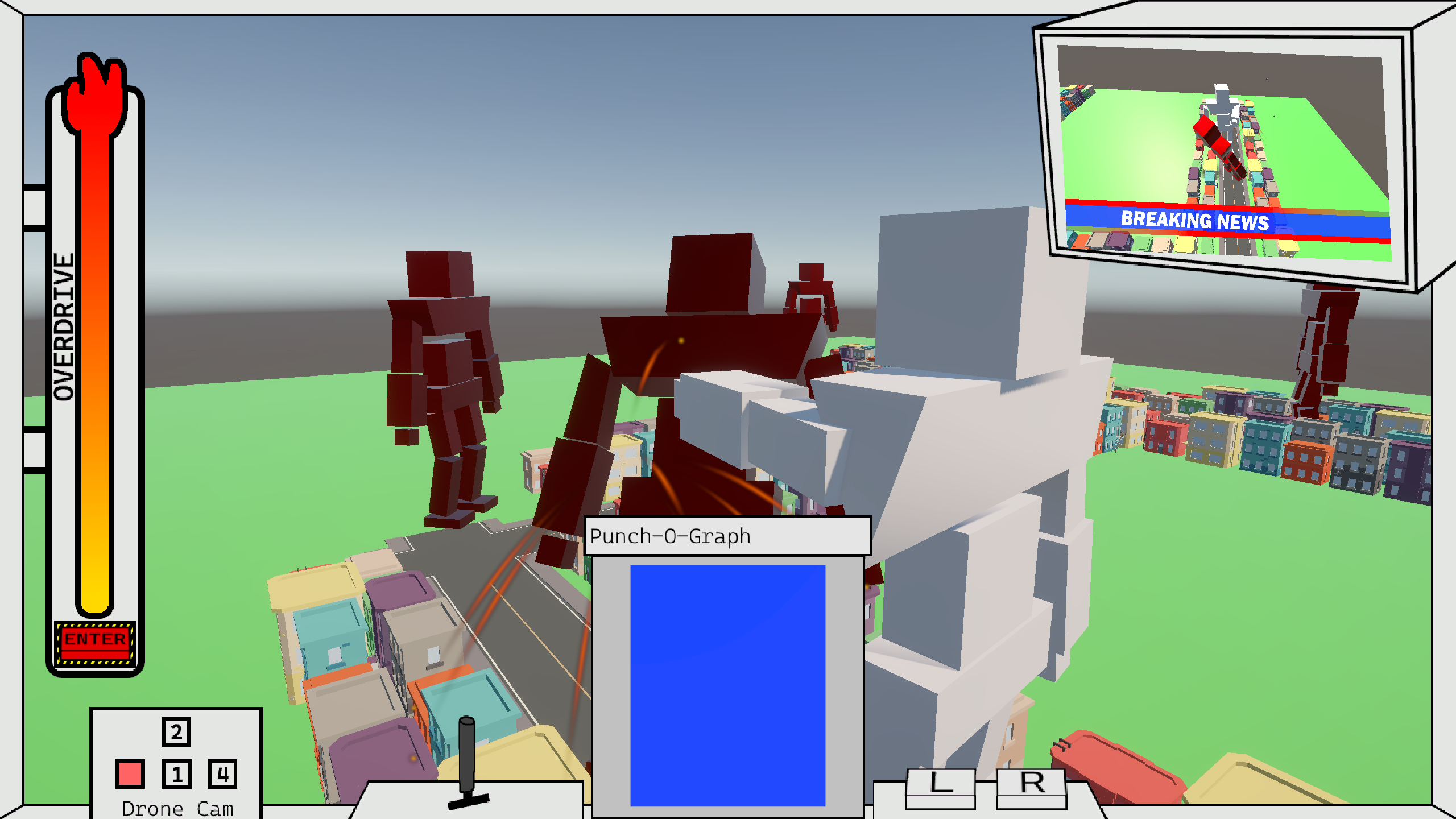
Use non-conventional controls to remotely pilot a weighty mech to brawl against enemy robots in the city!
Platform: Windows PC
Development period: October – December, 2025
Solo Project
Maximum Mecha Turbo Overdrive (which will be shortened to Turbo Overdrive from here on) is a tech demo I developed over the course of three months with the goal of creating a viable proof of concept that would effectively communicate fun of a robot fighter. To do this, I split my focus into two areas when prototyping: Making sure the mechanics functioned in the manner I envisioned them to, and making sure it felt satisfying to play.
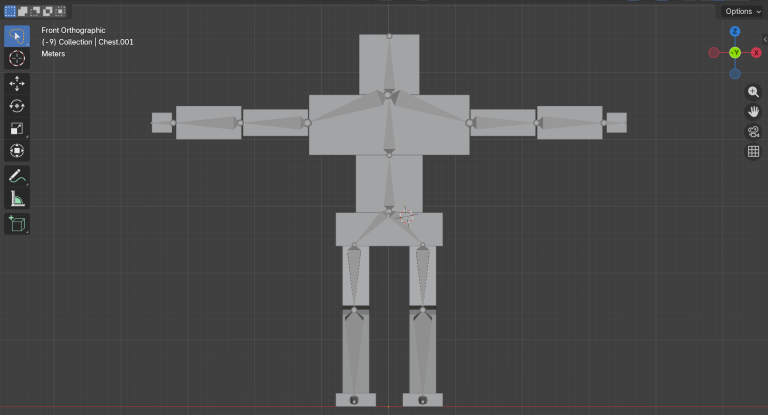
A screenshot of the custom rigged model, taken right out of Blender 5.1.0.
Starting with the functions, I knew that a non-standard control scheme was an inherent risk that would need a lot of attention to be successful. It needed to be made in such a way that it would reduce frustration while still providing satisfaction from “overcoming” how irregular it was. To make sure everything related to this core was attended to, I started from the ground up: The robot model was produced and rigged by me in Blender, something I had picked up for the first time just for this project, all so I could make sure the systems had everything they needed to work properly.

A demonstration of the rigged model working with an animation blend tree to produce dynamic knee bends.
With the model implemented in Unity, I continued to venture outside of my comfort zone, practicing more with the new Unity Input System package (which I was unfamiliar with at the time), and diving deep into animation trees to map these inputs to animation blends, allowing for the body to move dynamically based on player input. Getting the idea of a “manual punch” mapped to the players mouse motions functional was also a bit of a programmatic and design hurdle, especially with fixed camera points around the robot. By overcoming this challenge, I managed to create the games “Punch-O-Meter”, which not only helps players understand how to control the punching, but also created a unique way to “graph” the arc of a punch!

An in-engine demonstration of the building destruction.
With the core systems finally figured out, it was time to really give it the juice it deserved! A number of small details were added to really make it felt like you were having a large impact on the world. Buildings crumbling into dust, screenshake with every step and punch, and drawn out multi-explosion death sequences on enemies all made sure your actions felt as large as your robot. Even the robot’s size was taken into consideration during the earlier modeling step; I knew players would be able to tell something was off if I were to scale everything down around a small robot, so I never “cheated” with the sizes of things. All of the buildings are full-sized Unity buildings, and the robots really are that big! I also made the choice to have the cameras all be represented by in-world entities to further sell the scale of everything.

The games titular Overdrive punch in action!
Plenty of iteration was done based on player feedback and testing to dial in that emotional core of satisfying robot destruction. The ability to build momentum with your strides was added based on a request from a playtester, and the super-powered Overdrive punch came about from the sheer amount of fun I was having with a bug that made punches way too strong. I even made the whole games UI a cockpit that reacts to each input, not only to ease the learning curve of operating the robot, but also get an extra bit of playful immersion, making it feel even more like you’re puppeting the robot around.
While much more would have to be done to turn this prototype from proof-of-concept to a full title, it serves as an excellent exploration of finding the fun in a quick timeframe. By adapting to new tools and systems, I created a prototype that sells a clear emotional core that connects with players and makes it clear how and why the concept should expand.